Toronto, Canada
Friday February 6th, 2026 - Sunday February 8th, 2026
Friday – Limited Tune Up – Floor Judge
Pre-Event Planning
This area has been chronically identified as a weakness for me, so I decided to take an active role in planning this event. I took point on organizing the team briefing. By the end the HJ changed most of it, but I felt like I learned a lot during the process. The HJ wanted a very granular breakdown of tasks for the floor judges, since we knew the event was going to be around 1800 players, and the team was going be relatively inexperienced with Comp REL sealed. In addition to tag-teaming the briefing, I also played a ton of sealed before the event. I wanted to be prepared for the format and didn't want to be reading cards for the first time. I feel like it really helped me cleanly understand board states at a glance, since I recognized most cards, and helped a lot in my investigations.
Limited Expansion
The Limited Tune up was kind of a glorified RCQ, and yet somehow it managed to get 400 players. It was a little funny to have what was effectively a side event, get as large as our regional championships! While the main event was comprised of entirely pre-registered pools, this event was not. It was decided that we'd have players take a photo of their decklist before handing it in, to head off potential cheating. In the old GP days a very good cheat was to "lose" your decklist and then say you handed it in to a judge if questioned. While in reality you simply threw out your decklist, and built a newer, better sealed pool out of cards from home. This way if a player has no photo and no list it's a lot easier to imagine that something circumspect might be happening. The concern about players who didn't have phones or weren't able to take a photo was brought up and we decided that the solution for this would be to have the responding judge take a photo and give the player their name.
The Fabled Call
AP controls a Figure of Fable that has been activated once. NAP casts Abigale, Eloquent First-Year and chooses the Figure of Fable for its triggered ability. What is Figure of Fable's power and toughness? Figure of Fable is a 2/3. Power/toughness setting effects are applied in layer 7 and aren't abilities, so removing its abilities won't prevent the power/toughness setting effect from applying. (CR 613.1f)
Council Needed
AP was discovered to be missing one copy of Mistmeadow Council during a deck check. Upon further investigation, they surmised it was likely in their last round opponent's deck, due to an Oblivion Ring effect. Upon speaking with the previous round opponent they agreed that was likely, however they were also playing their own copy of Mistmeadow Council, and they'd drawn it during the current game! To make matters worse, both players were using identical sleeves, the ones Face to Face provided to all the players. This certainly was an odd, but very cut and dry example of a deck problem – game loss for AP's previous round opponent! (IPG 3.5) AP also got a game loss for presenting an invalid deck (39 cards).
This is the Life
After declaring blocks, NAP thought they were at 13 but AP thought NAP was at 9. After some investigation we determined that the life total discrepancy had occurred much earlier in the game when AP had attacked with Gloom Ripper, which gave itself +4/+0. Instead of taking 8, NAP had only taken 4, likely because they heard that it was getting +4 and just scrambled the numbers in their head. I ruled that NAP was at 9 and was not allowed to re-declare blockers. NAP is allowed to make poor play choices based on their own faulty information.
Saturday – Magic Spotlight - Appeals Judge
Morning Un-Met
I was curating the morning meeting for the PM shift, which came in at 9am (the AM shift came in at 8am and was starting the Spotlight as we arrived), and it was a bit of mess. Me and the other AJ running the meeting didn't coordinate, and so we ended up stepping on each others toes a bit. The other major issue was that I didn't write notes for what I wanted to talk about. There wasn't much to say so I figured it would all stay in my head. But when we got to the meeting area not only were there not enough seats for all the judges (it was the features area) but it was also freezing cold (so much so, that the features judges were later given hoodies by the TO) and we were fighting with the mic since Sealed procedure was going on at the same time. This all caused me to be knocked off-kilter enough that I completely forgot many of the things I had wanted to talk about. I haven't led a team meeting in a while, and this was a cruel wake-up call that there's no room for coasting in this area. I ensured this stumble wouldn't ruin my day, and I also made a point of embedding in my mind that I definitely needed to write some notes the next time I ran a team meeting.
A Checked List
There were a lot of things judges needed to check for upon receiving a player's decklist. Player name, table number, signed waiver, registered deck, registered basic lands, verifier's name and whether or not the player took a decklist photo. Needless to say near the end of registration there was no way I was able to check all the lists being forced into my hands for all of these things, but I sure did try!
Semi-Continuous Construction
We were giving players until R1 was paired to change the basics in their deck. Either adding basics if they'd forgotten to register any at all, or updating a sub-40 card list with a basic to avoid a game loss (unless they determined the 40th card they wanted to play wasn't a basic, in which case they could change their list but not avoid the game loss). They were also allowed to change the composition of the basic lands they'd registered. I thought this was a pretty interesting streak of leniency from the HJ, but wasn't opposed to it. Officially we gave them ten minutes for this, however this time was also used to drop no-shows and allow the scorekeeper to sort out any other shenanigans.
Designated Driver
Similar to previous Spotlight events, each AJ was designated a team to oversee. There are a lot of awkward and embarrassing things that can go wrong during checks, and so while not every team got an overseer, checks was one of them. I imagine I was given checks because the lead was fairly strong, so it was a good match for myself as a weaker appeals judge. The checks team was on break in round 3 and myself and the team lead decided that since the break schedule was a little thin on floor coverage, we wouldn't have the breaks team do checks while the team was gone.
Another thing you might notice looking at the schedule is that all the breaks are by team and by round. I was talking this over with another judge and they mentioned that letting teams organize breaks internally when you have an event of this size is usually better because it means that there is less passing off of tasks, and thus less room for error. They also mentioned that breaks by round can be awkward if the event drags a lot and it might cause issues if people are trying to coordinate food or with other judges or players.
A Messy Situation
During build AP wet themselves. They were moved away from the other players and allowed to finish build. However when they were told they needed to go change before returning to play round 1, they appealed. This was brought to me and I was a little caught off guard. This was just so far out of range of what I have dealt with in the past, I initially wasn't sure what to do. I felt that letting them play in soiled clothing was simply not an option so after re-centering myself, I decided to uphold the ruling. Luckily while I was talking to the responding judge that brought the call to me, it seemed that the player managed to find their way to the TO, which saved me a pretty awkward conversation.
Innovative Sequencing
AP controlled Sanar, Innovative First-Year, and before drawing their card for the turn they revealed three cards for Sanar. The order of the cards was maintained, so I ruled that they had revealed the card they were drawing for the turn, and that from here they should resume resolving Sanar with the remaining two cards. This is certainly an interesting approach to this scenario, but we generally try to interpret players actions as legal whenever possible.
Rulings, the Gathering
AP had announced their Gathering Stone trigger, but then drew a card without revealing it. I ruled this was a GRV, since they'd remembered their trigger but forgotten to execute it. We rewound to the resolution of the trigger, which resulted in us putting a random card from their hand on top of their library and letting them look at it, and either reveal it if it was the appropriate type or put it into their graveyard. (IPG 2.5) After discussing this call with another judge, however they mentioned that like the previous paragraph, perhaps this should've simply been ruled "you chose not to reveal and not to mill", as that is a legal interpretation of events. Upon reflection I do feel this is more correct.
Innovative Accidents
By far the biggest problem child of the event was, Sanar, Innovative First-Year. This card is just staggeringly hard to parse and has a lot of fiddly little details that are easy to miss. In this particular call, AP had been putting the cards revealed by Sanar on the bottom of their library instead of shuffling them into their library. The violation here was TE-insufficient shuffling and the fix is to have them shuffle their library now. (IPG 3.9)
Significant Figures
AP controlled Figure of Fable. Its first ability had been activated and it had previously been the target of two Surly Farrier activations. NAP then cast Noggle the Mind on it, what is its power and toughness? Noggle the Mind sets its base power and toughness to 1/1 which occurs in layer 7b (CR 613.4b) which is the same layer that Figure of Fable's power/toughness setting ability operates in. However Noggle the Mind has the more recent timestamp so it takes precedence. Surly Farrier's ability applies in layer 7c, so it applies after Noggle the Mind's ability.(CR 613.4c) Resulting in the Figure being a 3/3.
Eloquent Interactions
AP casts Abigale, Eloquent First-Year and chooses to target their Lys Alana Informant. Afterwards NAP casts Curious Colossus. What abilities does Lys Alana Informant have? None. Ability removing effects and keyword counters both apply in layer 6. Curious Colossus has the more recent timestamp and thus all abilities granted by the counters will be quashed. (CR 613.1f)
Partially Correct
If AP activates Lluwen, Imperfect Naturalist's ability but fails to discard a land, does the GRV partial fix for failing to discard apply? Debatable, by the text of the IPG it seems like it would apply, but in practice that would give us some very weird outcomes, such as what we do if AP no longer has a land in their hand. In that case would it simply do nothing? Then we'd be effectively telling NAP that AP has no lands in hand. (IPG 2.5) This wasn't a call that I took (or even happened on the event) but a discussion that came up as a bit of a thoguht experiment. By the end of the event most people were on of the opinion that the partial fix shouldn't apply here.
Aggressively Incorrect
AP attacks with Kinscaer Sentry and puts Figure of Fable onto the battlefield, notably not tapped and attacking, and a judge is called. This is a GRV for AP, certainly, but do we rewind to the selection of the creature, or do we merely say the creature must be tapped and attacking, and that the selection was legal, but it was not put onto the battlefield correctly? There is a similar scenario with Dryad Arbor and Grafdigger's Cage, where AP is allowed to select Dryad Arbor but it won't enter. And we don't let them select a different land after the infraction is discovered. This feels pretty similar to me, so I think I probably wouldn't allow AP to make new decisions for their ability, and would simply rule that Figure is tapped and attacking.
Noggles Abound
AP casts Scarblade's Malice on their creature and after it resolves NAP casts Noggle the Mind on it. What abilities will it have, and what will happen when it dies? It won't have lifelink or deathtouch since those are both applied in layer 6 which is also where Noggle the Mind applies, and Noggle has a more recent timestamp. (CR 613.1f) However when the creature dies AP will still create a 2/2 elf token. That's because that delayed trigger from Scarblade's Malice is created by the resolution of the spell and isn't an ability granted to the permanent.
Rewinding the Turn
AP controls Creakwood Safewright, and says "pass". NAP untaps and draws at which point AP says "oh wait, I had a trigger". I ruled reversing decisions as NAP untapping and drawing isn't new information, and in this format it's very rare that anyone ever does anything during their draw step or upkeep. Notably NAP was tapped out during AP's turn and couldn't cast any spells during AP's end step either. (MTR 4.8)
Wistful Triggers
AP controls Flaring Cinder and casts Wistfulness, drawing two cards and discarding one before resolving their Flaring Cinder trigger. This is a GRV since they should've resolved the triggers in the other order. The option here is to either back up or not, and since the main corruption to the game is the fact that AP had more information and cards when electing whether to discard to Flaring Cinder or not, I decided that a backup likely wouldn't really change much, so we left it as is. (IPG 2.5)
Dusk of the First Day
It was a hectic day, but I had a lot of fun. Answering interesting calls all day is kind of my dream job at an event like this. By the end of the day I had one DQ, seven appeals, one overturn and three investigations. Other than my abysmal morning briefing I felt like it was a strong day for me. I made an effort to check in with all the team leads, not just the team lead I was assigned to, and I made sure to keep in good contact with the deck checks team, occasionally assisting them with some checks from time to time.
Sunday – LTQ Appeals Judge
Learning From Our Mistakes
I was lucky to have an immediate second chance to do a team briefing. This time I coordinated with my HJ and fellow AJs about what we'd be talking about and I made some notes about what I'd be saying. I opted to explain the sealed procedure. I made a list of notes for myself. Because of this I think the briefing went a lot better on Sunday.
Mom and Dad are Fighting
AP took a photo of their pool and decklist and then realized after pairings for round 1 were posted, that they had mis-registered a card. It was clear what they intended to play, since their decklist photo also included their physical deck, and the card that they had failed to register. While the player was telling me this, one of my TLs mentioned that this player had already asked my HJ and been told no. I told the player to wait while I spoke with the HJ. Other than taking a number of different deck/decklist photos and then deciding on the correct build later, there didn't seem to be a lot of avenues for abuse, and the above is a bit egregious. We ended up agreeing that it would be fine for the player to change their list without a penalty. However neither of us were terribly thrilled about the player shopping around for a different answer, so I issued a USC-minor to them.
Red-Hot Investigation
AP only controlled one red source, but cast the Brambleback Brute and Cinder Strike on the same turn. AP had a hand full of red cards (Brambleback Brute, Cinder Strike and Elder Auntie). There was very little in play as it was only turn five. AP hadn't tried to tap for more than one red on any previous turn, and it was their opponent who noticed the error. According to NAP the match was a bit of a race to the finish, and tapping for double red here really allowed AP to genrate a lot of momentum. According to AP they didn't think they were going to win this game without tapping for double red. It was round one of the Limited Championship Qualifier, and due to the number of players it was unlikely X-2 made it into the top 32. However if this was intentional, with such a barren board state it's not an easy cheat to obfuscate. While this was very borderline, I decided it was less likely that they were cheating than not, and issued the GRV and rewound the game to before AP cast the second spell.
Mighty Confusing
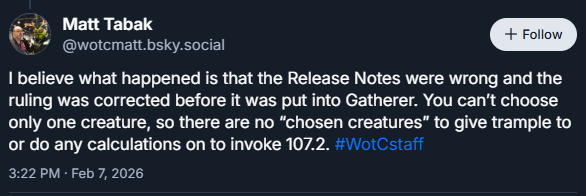
Spry and Mighty is a bit of a confusing card. It's even more confusing when you wonder what happens if AP only has one creature as the spell resolves. According to the Gatherer ruling it won't do anything as it resolves. However according to the release notes, the creature will get trample. Reading the CR as written implies that the creature will get trample, but a post from Matt Tabak on Bluesky actually supports the Gatherer ruling. For Sunday I said we'd be ruling with Tabak.
Omens Abound
AP controls Cast Through Time and casts Skimming Strike, what happens? Both the shuffle effect from Omen and the exile effect from rebound are replacement effects, so the owner of the affected object chooses the order to apply them in (and after the first applies the second will no longer apply). (CR 616.1)
Mana, Ho!
AP controls Ashling, Rimebound, can NAP cast Glen Elendra's Answer and counter the mana generation trigger? Yes. Ashling's ability isn't a mana ability, since it doesn't trigger off the activation or resolution of another mana ability, so it uses the stack. (CR605.1b)
Substitution Confusion
AP is playing Brigid, Clachan's Heart and is using the substitute cards to represent it in their deck. What happens if both Brigid and the substitute cards get shuffled into AP's library? This is a little odd. If AP isn't using sleeves or is using transparent sleeves, then I feel we can remove the DFCs without a penalty. Similar to if a token was shuffled in. If the sleeves are partially opaque such that an opponent might not notice immediately that there's a DFC shuffled in, and the DFC is in the same sleeves as the rest of the deck, then things become a bit more awkward. By the book I believe the infraction is still to simply remove the DFCs and carry on with no penalty. (IPG 3.5)
Notes For Any Time
Can AP's sideboard notes consist of information unrelated to sideboarding? Yes. The MTR doesn't specify what kinds of notes players are allowed to bring in, it merely stipulates that they are only allowed to look at them in between games. (MTR 2.11)
Winner's Reward
The number of rounds for the Limited Championship Qualifier was mandated by WotC, which meant that the event was slated to end after the hall closed. Therefore the plan was to have all the players uber over to the Face to Face storefront to play out top 32. This was a little awkward for a few reasons, first it was not only a long day for the staff but a long day for the players as well. The event started at 9:15am and top 32 wasn't done until about 2:45am the next day. Next we lost a lot of time to the venue change over. The store was about a 30 minute drive from the venue, but instead of renting a bus or purchasing ubers for the players, each player was instead given a $20 travel stipend and encouraged to find their own way there. This has benefits and costs, the benefit is that if a player uses their own vehicle they don't get screwed. This system also encourages players to uber together to game the system. I like it when players who are otherwise rivals are incentivized to cooperate. When the players arrived at the store they were treated to a sushi dinner, which I felt was a nice touch. Finally after all was said and done we had 32 players ready to participate in a called draft and play a single elimination bracket.
This provided its own set of challenges. We didn't have stamped or sleeved product, just some good ol' fashioned booster boxes. If players opened a Double-Faced Card they were told to hide it from the table and judges would come by to assist with sleeving the whole pack. After the draft was done, players were instructed to write their name on the front of their registration sheet, and their seat number on the back. At this point players were told to leave their drafted pool face down on top of their registration sheet and stand up. Pod 3 seat 1 would swap places with pod 1 seat 1, pod 3 seat 2 would swap paces with pod 1 seat two and so on. This way we'd have people in different pods registering each others decks. This is to avoid any adding cards to pool shenanigans. For build we did something similar, we had seat 1 from each pod all build at one table, seat 2 from each pod at another table and so on, to prevent people from the same pod building adjacent to each other. Overall the process was a bit messy and there was some amount of confusion but I think it accomplished the goals that we set out.
...In Conclusion
I was very excited for the opportunity to be an appeals judge on this event, and I was glad that I'd had a bit of a break before working the event. It allowed me to spend some extra time and effort preparing for the event and being ready for the format. I had a great time answering questions, felt challenged, and even felt like my investigations were better than at previous events. While it was a tiring weekend, I'm so grateful for the opportunity and would do it again in a heartbeat.